




CEDX SYSTEMS Talk to sales

Solutions

Business software, prewired.

CEDX is the software a services firm runs on — CRM, quotes, e-signature, projects, invoicing and a help desk — all writing to one customer record, on one login and one bill. It is built for firms of 5 to 50 people that bill for time or projects. Today that firm has six logins, six bills, and a customer record in none of them.

Send us the six bills

What you pay for now, and how many people you have. Back comes what CEDX replaces, what stays where it is, and what it costs for that many people.

Or open the catalog first

Every application has a page you can read before you speak to anybody.

Where it actually goes wrong

Pick the one that happened to you this week.

These are not categories, they are Tuesdays. Underneath every one of them is the same fault: the client exists as separate rows in separate databases, and nothing reconciles them except a person who is also doing three other jobs.

One record

Nothing breaks inside a team. It breaks in the gap between two of them.

Sales is fine. Finance is fine. The invoice is wrong because the two of them keep separate copies of the same client and only one copy heard about Thursday. CEDX removes the copies instead of syncing them. There is no connector, because there is nothing to connect — nothing to buy, nothing to re-authorise, nothing to reconcile after a failed nightly job.

The trace

Follow one job across six applications. Count how many times the client gets typed in.

A walkthrough of how the software behaves. Read the transitions rather than the stages — the stages are where your work happens, the transitions are what you are actually buying. The answer to the heading is one, at the top.

01

Enquiry — CEDX CRM

An email, a form, or a phone call somebody writes up afterwards becomes one company and one contact. This is the only place the name is keyed.

02

Proposal — CEDX Quotes

The scope is priced as lines against that record. Name, address, terms and rate card are already there to price against.

03

Signature — CEDX Sign

The signature goes on the quote itself rather than on a separate document you export and re-upload. The executed version stays on the record it was priced from.

04

Delivery — CEDX Projects

The job opens against the signed scope. Hours are logged against the same client, sitting next to the price that was agreed for them.

05

Invoice — CEDX Invoicing

A won deal drafts its own invoice. Nobody re-keys the client, the lines or the amount, so nobody can re-key them wrong.

06

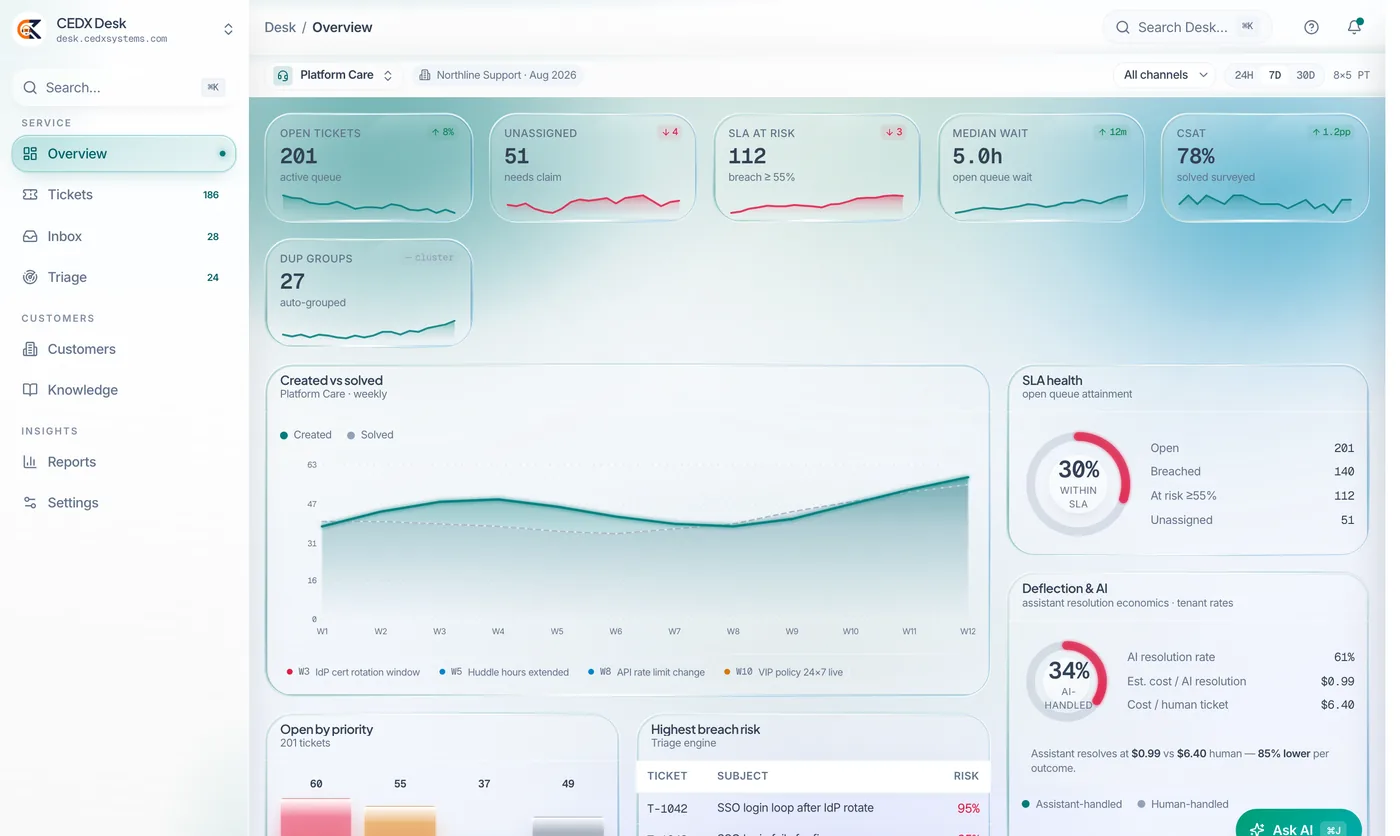
Support — CEDX Desk

The ticket opens on a client that already carries the deal, the signed scope, and whether the last invoice was paid.

What you switch off

Six logins out. Six applications in, on one login and one bill.

By category, not by vendor. We are not going to print the names of the tools you are running, and we are not going to tell you they are bad — most of them are good at the one job they were built for. Read down the left until you find the bill you are trying to cancel.

Your CRM

Companies, the people at them, and every conversation you have had. This is the record the other five read from.

CEDX CRM
Your proposal template, and the PDF you export from it

A scope priced from your own rate card, kept as lines rather than as a document, with the version the client actually saw.

CEDX Quotes
Your e-signature subscription

The signature lands on the quote instead of on a copy of it, so the signed terms and the billable terms cannot drift apart.

CEDX Sign
Your time tracker and the project spreadsheet

Tasks, hours and budget held against the signed scope, so what the job cost is a lookup rather than an investigation.

CEDX Projects
Your invoicing tool

Invoices drafted from deals that were already won, against clients who already exist, in the terms already agreed.

CEDX Invoicing
Your shared support inbox

Client email as tickets attached to a customer, visible to more than one person, and searchable after that person leaves.

CEDX Desk

The catalog

The second application is not an integration.

That sentence is the reason the count below is worth printing at all. Adding an application is a permission rather than a project: it opens on the customer record you already have, under the login you already issued, as a line on the bill you already receive. The catalog is a shelf, not a shopping list — most of this page is about six of the 132. Fourteen domains, and the counts add up to it. Check them.

Platform & Identity

CEDX Admin and CEDX Vault. The login, the roles and the audit trail everything else runs under.

10
AI

Drafting and extraction on records you already hold. The smallest domain but one, and nothing here is required.

5
Sales & CRM

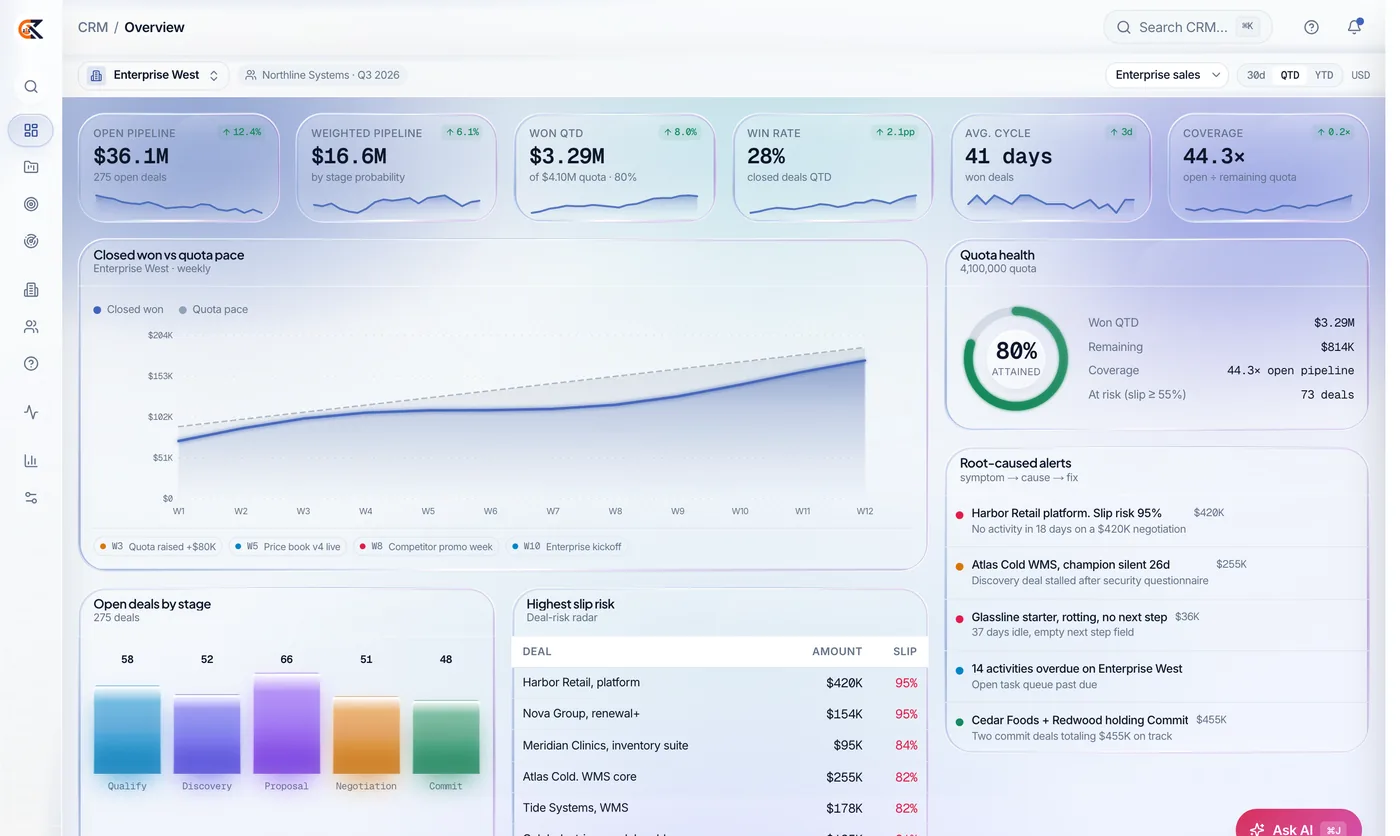
CEDX CRM and CEDX Quotes. Where the customer record is created, and where most firms start.

10
Marketing

Campaigns, lists, forms and events, writing to the same record your invoices are raised against.

12
Customer Service

CEDX Desk, and the queues, client portals and knowledge bases around it.

9
Finance & Accounting

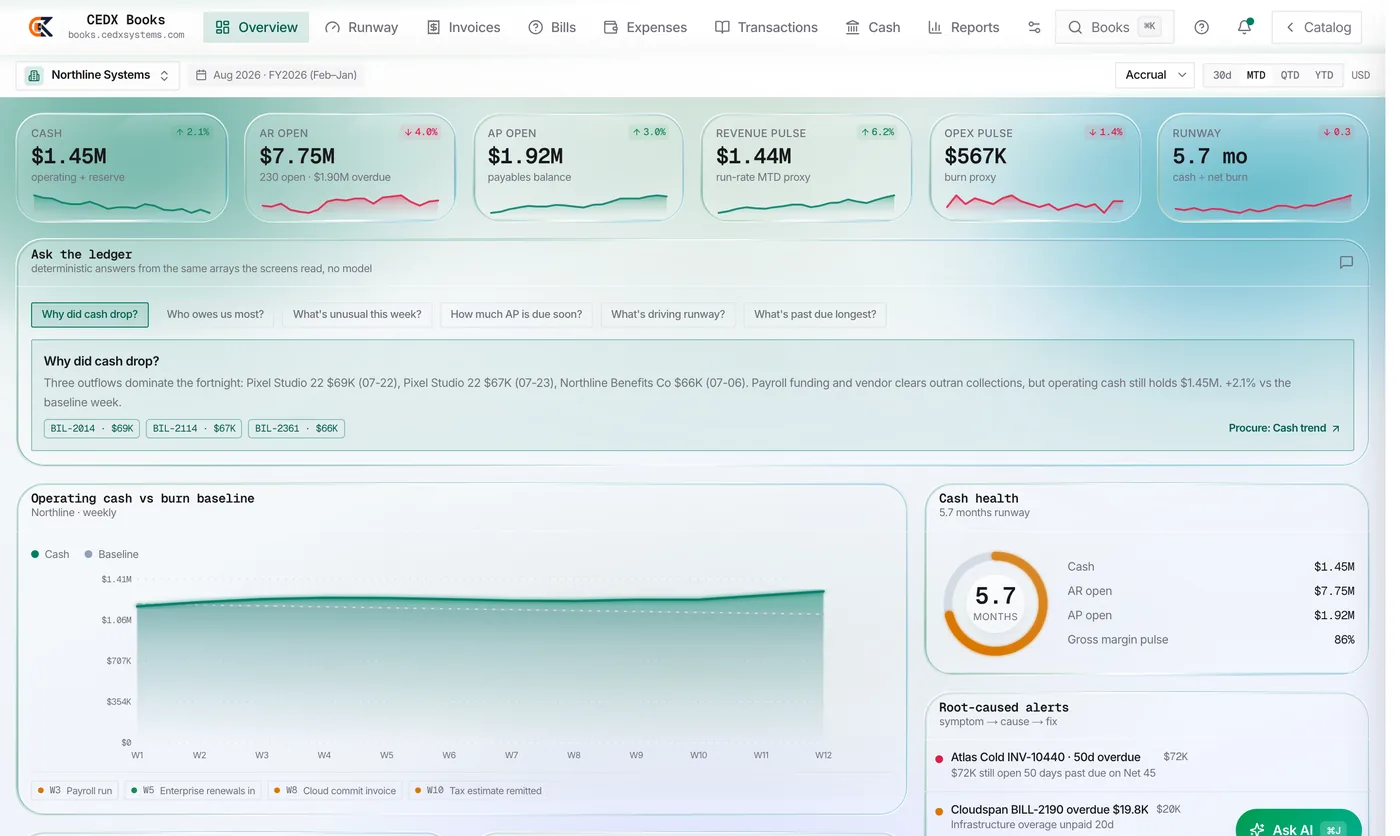
CEDX Invoicing and CEDX Books. The largest domain in the catalog, and the one you adopt last.

14
Commerce & Retail

For firms that also sell something other than their hours.

7
Operations & Supply Chain

The smallest domain. Most services firms never open it, and that is the correct outcome.

6
People & HR

CEDX People. Hiring, onboarding, leave, and the contractor who invoices you rather than the other way round.

11
Projects & Delivery

CEDX Projects. Scope, tasks, time, and what the job actually cost against what it was sold for.

8
Workplace & Collaboration

CEDX Files and CEDX Sign. Documents, signatures and the drive the signed copy stops getting lost in.

12
Data & Analytics

CEDX Insight. Reporting across the record itself rather than across four exports in a spreadsheet.

7
Developer & Low-code

CEDX Workflow. Changing what the software does without buying more software to do it.

9
IT Management & Security

Accounts, devices and access — the part that starts mattering the week you pass ten people.

12

What stays where it is

What you keep. We are not asking for your accountant.

The fastest way to break a firm of twelve is to ask it to replace everything it depends on in one quarter. Nothing on this page requires you to move any of the following, and we are not going to hang a wall of integration logos here in place of answering.

Starting small

Buy one application. That is a normal way to arrive here.

You are not going to believe a catalog on a Tuesday night, and you should not. One application, on one login and one bill, is a complete way to buy this. Below is the order it goes in — not a timetable. We are not quoting you a number of weeks, because we have not measured it across enough firms to state one honestly, and an invented number is exactly what the rest of this page is refusing to do.

01

Take one, and take the one that hurts

CEDX Desk if support is the fire. CEDX Invoicing if the money is late. CEDX CRM if the client list is the problem.

02

Bring the client list across

Companies, contacts and open deals import from CSV and you map the columns once. Attachments, historic email threads and automations built inside another vendor's tool do not come across.

03

Issue the accounts

One account per person, including the part-timer and the contractor. Roles decide what each of them can see.

04

Run both until a month closes cleanly

Keep the old tool open until one full month has been quoted, delivered and billed out of CEDX. This is the step firms skip and then regret.

05

Add the second application, or do not

The second one is not an integration project — it opens on the record you have already built. Plenty of firms stop at one, and nothing on the bill changes until you switch something on.

Evidence

The things we do not have, next to the documents we do.

There is a standard set of furniture that belongs at the bottom of a page like this: logos, a rating badge, an uptime figure, a quote from a happy operations manager. We have none of it. Here is that stated once, in the same size type as everything else, beside the paperwork that does exist and can be read in full before you speak to anyone.

Asked before every demo

The questions you were going to ask someone else.

Answered flatly, including the two that are against our interest.

Your CRM will not be as good as the dedicated one I already have, will it?

No, and we are not going to argue the point. The deepest single-purpose tool in any category will out-feature the CEDX application that does that job. What it will never be is the same row your help desk is reading, or a system that knew the deal was won.

Will migrating eat my December?

We will not quote weeks we have not measured. What we can tell you is the shape: one CSV import you map once, both systems open until a month closes cleanly out of CEDX, and no attachments, email history or another vendor's automations coming across.

What if we only want the CRM?

Then buy CEDX CRM and nothing else. One application, one login, one bill is a legitimate way to buy this. The only difference from a point tool is what happens on the day you want a second one.

Who else is using this?

We are not going to show you logos we do not have, or invent a quote from a customer who does not exist. What is checkable today: 132 application pages, the security page, the SLA and the data processing addendum, all readable without talking to anyone.

What happens to our data if you get acquired, or shut down?

It is your data, and the terms that govern it are in the contract rather than in a sales conversation. Read the data processing addendum and the terms before you sign — including before you sign ours.

Who administers it once it is in?

One person. Firms of this size mostly have no IT staff, so "provision the new hire in six tools" has to become one account in one place, and that is what one login is for.

Two things to do

Send us the six bills.

Not a demo request, not a gated PDF, not a discovery call about your digital strategy. One ask, and one escape that does not involve us at all.