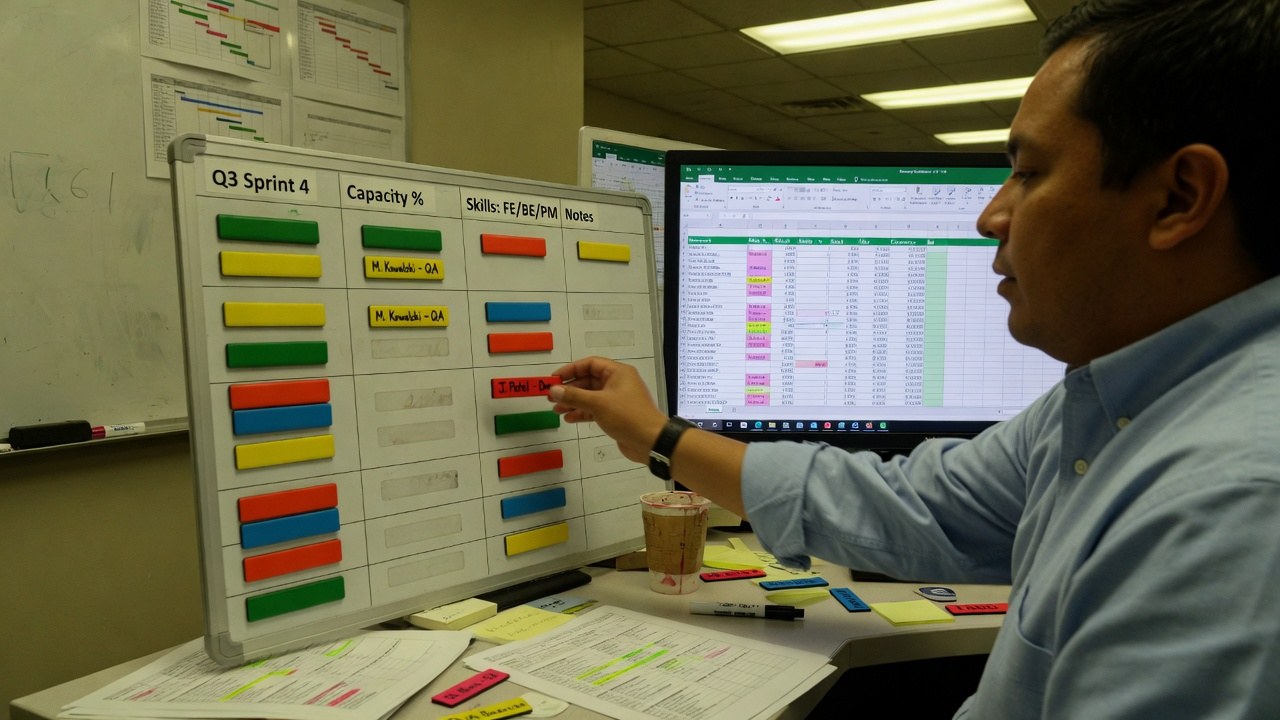
Resourcing plans people against weeks: 1,124 hours planned for W31 against 932 hours of capacity, ten people over 100%, the bench priced at $107K of idle cost. The over-allocation is on the grid before it is in the exit interview.
The grid does the thing spreadsheets hide: one consultant's W31 cell reads 320%, four jobs, one person, same week. You cannot fix what you cannot see, and this you can see from across the room.
resourcing.cedxsystems.com: live build
Runs on demo data. The 24 people in the captures are the seeded demo roster.
1,124h planned for W31against 932h of capacity: 121% load
10 people over capacityutilisation above 100% this week
$107K bench idlecost × free hours, priced on the card
What it is
Three truths staffing spreadsheets keep quiet.
The person-by-week grid admits the collision
Eight weeks of schedule, person against week, with tentative hours hatched and leave in a diagonal pattern. Jade's W31 reads 320%; an engineering manager on a 20-hour week reads 280%, 300%, 220%, 160%, 260% across five weeks. Leave and work in the same cell is visible, not discovered.
424 over-hours to rebalance, totalled on the card
PTO marked diagonally in the grid: W36 shows it for two people
Under band: 2 people below 70% util
resourcing screen-2
Skills are on the roster, not in someone's head
Twenty-four people with role, practice, utilisation, free hours this week and over four weeks, and skills on the row: “Inventory, QA, React”, “Tax, Checkout, SQL”. The bench-ready count of 14 is computed from ≥40 free hours over four weeks, not guessed.
Free 4w column: 0h to 132h across the roster
Filter chips: Over, Bench, and each practice
Search across name, role and skill
resourcing screen-3
Unfilled demand is a placeholder with a button
Six open placeholders spell out the role, skill, weeks and load (senior checkout engineer, 24h/week, P0, W32 to W36), 129h/week of unfilled demand in total. Each has a Find match button that reads the roster's skills and free hours instead of starting a email thread.
320 allocations: person × project × week
3,708 confirmed hours across all weeks
States on every row: Confirmed · Tentative · Soft
resourcing screen-4
Product tour
Four screens, captured from the running build.
Not a mockup and not a concept deck. This is what opens at /app/resourcing.
resourcing.cedxsystems.com
01 Overview
The week's load, scored
Planned 1,124h against 932h of capacity, average utilisation 149% among people with load, 178 person-week conflicts scored with 20 rated high. The alerts name names: one senior consultant at 128% (52h planned on 40h) and leave colliding with a cutover, 24h confirmed plus 18h tentative while away.
Capacity health 56%, components listed beside the ring
Person against week for W31 to W38: utilisation per cell, tentative hours hatched, leave diagonal. The over-capacity count of 10 and the 424 over-hours to rebalance come straight off this grid, and so does the fix, because the free cells are on the same screen.
Cell range in view: 10% to 360%
Two people marked under band, below 70%
Legend on screen: over · tentative · leave
03 People
A roster that knows its bench
Twenty-four rows of who can do what: role, practice, this week's utilisation, free hours now and over four weeks, skills. The 180% platform engineer has zero free this week but 76h over four; the 70% mobile engineer has 100h. The rebalancing shortlist writes itself.
Avg util 124% this week across the roster
Bench-ready 14: ≥40 free hours over 4 weeks
Skills as comma tags on every row
04 Allocations
Confirmed, tentative, soft, and the gaps
320 allocations with hours, percentage of week, state and match score on every row. Above the ledger, the six placeholders of unfilled demand wait for a person, each with role, skill, weeks, priority and a Find match button.
W31 planned: 1,124h across 51 allocations in view
Match scores printed: 36% on the top rows
Filter by week and state: Confirmed · Tentative · Soft · Over
Who runs it
Three roles live on the grid.
Roles, not references. We have no named customers yet, so nobody in these photographs is quoted, credited or claimed as one.
Resource manager
Owns the person-by-week grid. A 320% cell is fixed with a trade in week 31, not with an apology in week 38.
conflicts · 178 scored
Delivery lead
Reads the placeholders: six unfilled roles at 129h/week is the hiring-and-borrowing agenda, with priority P0 to P2 already attached.
unfilled · 6 roles
Consultant
Sees their own week as it is actually planned, with confirmed, tentative and soft hours separated, instead of hearing about the fourth project at the fourth kickoff.
states · confirmed / tentative / soft
The shape of it
What the demo roster actually looks like.
Every figure below is legible in the captures above. Nothing here is a projection of your estate. It is the state of the demo data.
24people on the roster12 delivery · 4 advisory · 4 platform · 2 CS · 3 internal
149%avg utilisationpeople with load, W31
424hover-hours to rebalanceacross 10 over-capacity people
129h/wkunfilled demand6 placeholders, P0 to P2
Utilisation distribution, 24 people, W31the banding the capacity grid is read against
Over 100%: the rebalancing list10
90% to 100%: fully loaded, not over4
70% to 90%4
Under 70%: the bench band6
Capacity healthplanned 1,124h / 932h · 20 high conflicts
56%
Health 56%: load, conflicts and bench blended
Bench idle priced at $107K of free-hour cost
W31 load against capacitythe bar fills to capacity; the plan over-fills the week
Planned 1,124h, 121% of the 932h week
Capacity 932h across 24 people
How it runs
A staffing week, in the order it happens.
01
Demand
Work arrives as placeholders: role, skill, weeks, hours and priority. Six currently unfilled at 129h/week, waiting for a person rather than a hope.
02
Match
Find match reads the roster's skills and free hours. The match score is printed, 36% on the current top rows, so a weak match is visible as weak.
03
Allocate
The allocation lands on the grid as confirmed, tentative or soft. 320 allocations make up the week: 1,124h planned, 424h over capacity to rebalance.
04
Rebalance
Conflicts are scored per person-week, 178 of them, 20 high, and the grid shows where the hours can go: the bench-ready 14 with ≥40 free hours over four weeks.
One record
The same people, planned and lived.
Resourcing plans the week; the rest of the estate lives it. The grid, the timesheet and the roadmap are three readings of one roster.
Finding this out on the third call is worse for you than reading it here, and worse for us.
Resourcing is not generally available. What opens today is the live build on demo data: the 24-person roster and every allocation in the captures is seeded.
We have no named customers to show you, so this page shows none. The people on the grid are demo personas, not references and not real employees.
The bench-idle dollar figure is cost × free hours on a seeded cost basis. It illustrates the mechanic; it is not a payroll reading.
Match scores read skills and free hours only. They do not model preference, development goals or availability nuance. The planner still decides.
No audit or compliance certification has been issued for Resourcing. What we can evidence about hosting, encryption and access is on the security page.
Yes. Every screenshot is a capture of the running build and you can open the same build at /app/resourcing. It runs on demo data.
What does a 320% week mean?
Four allocations landing on one person in one week, 320% of their capacity, rendered in red on the W31 cell. The grid total computes the damage: 10 people over 100%, 424 over-hours to rebalance.
How does Find match work?
Each unfilled placeholder carries role, skill, weeks and load. Find match reads the roster for people with matching skills and free hours in those weeks, and prints a match score. The current rows read 36%, which is the product saying the fit is weak, not hiding it.
What counts as bench?
Computed, not declared: bench-ready means at least 40 free hours over the next four weeks, 14 of the 24 demo people qualify, and the bench-idle card prices the free hours at $107K of cost.
Does it know about leave?
Yes. Leave is marked diagonally, directly in the person-by-week grid, and the overview alerts on the collision: “24h confirmed + 18h tentative while on leave.” The records themselves live in CEDX Leave.
Is Resourcing audited or certified?
No certification has been issued. What we can evidence about hosting, encryption, tenant isolation and production access is written up on the security page.
Next week's grid already exists. See what it says.
Live build, demo data, no card. Then count how many of your people would read over 100%.