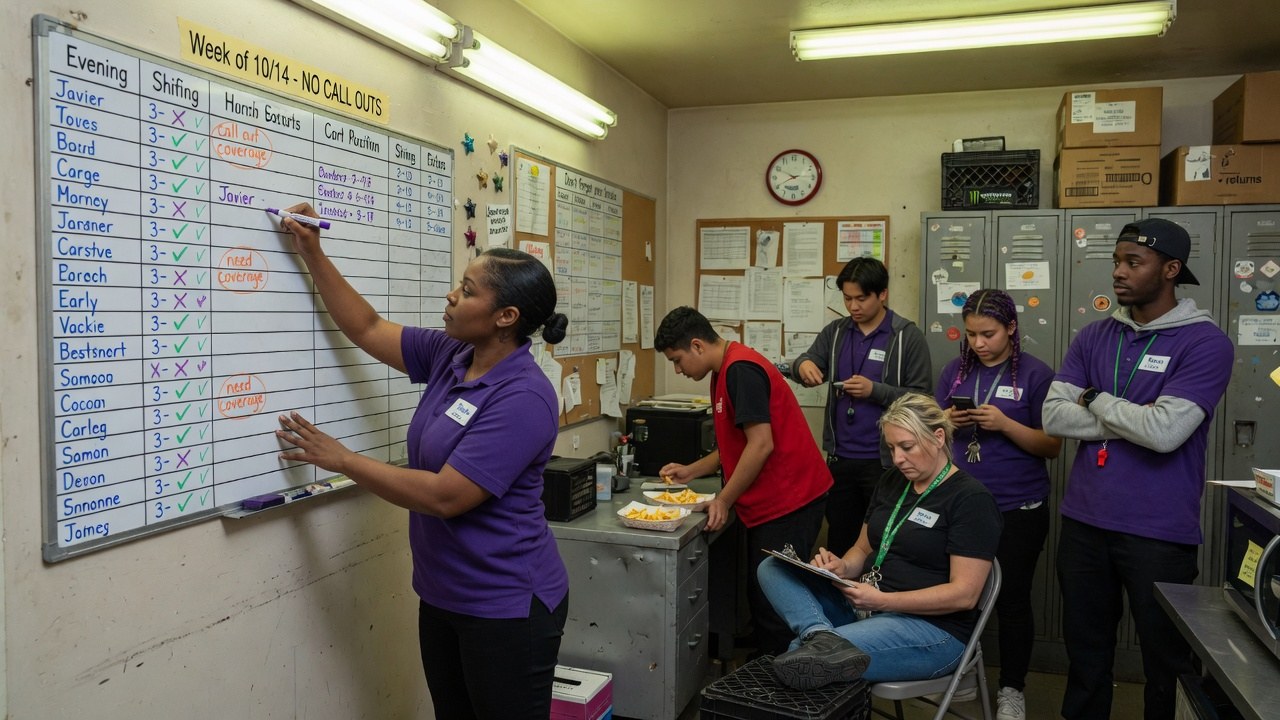
A shift lead updating a dry-erase roster on a break-room wall while staff gather for the handoff, lockers behind them.

CEDX Shifts · People & HR

The week's seats,
filled or priced.

Shifts builds the week from templates, fills it against declared availability, and prices what is left open: 183 seats short across six locations, 365 overtime hours at a $22K premium, 17 swaps waiting on a manager.

The overnight SRE seat in Denver is open and the backup is already over weekly hours. The alert prices it at $2.4K — before Monday night, not after the incident review.

shifts.cedxsystems.com — live build
CEDX Shifts overview: 320 shifts this week, 183 open or short, 65% coverage, 365 overtime hours at a $22K premium and 17 swaps pending.

Runs on demo data. The schedule names itself Northline Schedule · Week of Aug 4 2026.

320 shifts this week183 open or short · 43 claimable
65% coveragefilled against required, by day and location
365 overtime hoursa $22K premium on a $163K week

What it is

Templates, availability, and the seats left open.

The schedule as a fill ledger

Three hundred twenty shifts with day, window, role, location, assignee, status, fill and hours per row — a Support L1 seat filled 3 of 4, an overnight SRE window open 0 of 2. Generate schedule is a button on the board, not a separate tool.

  • Six locations from SF Support to London Desk
  • Fill fractions per row: 3/4, 0/2, 4/6
  • Status: Scheduled · Open · Filled · No-show
shifts — screen-2
The schedule as a fill ledger

48 templates build the week

Lead shadows, night cover, weekend surge, on-call blocks and float pools — each template carries role, window, days, locations and applied count. Six hundred sixty-six instances on the schedule came from forty-eight templates.

  • 40 active · 8 draft or inactive
  • Applied counts up to 29 per template
  • Windows like 22:00–06:00 on the row
shifts — screen-3
48 templates build the week

Availability is declared, not guessed

One hundred twenty rows of person-by-window preference: Preferred, Available, Limited, Unavailable — with hours and a conflict flag. Forty rows are blocked against the schedule, which is why the schedule knows its own gaps.

  • 31 declared preferred windows
  • 40 conflicts blocked vs schedule
  • 25 people unavailable, zero hours
shifts — screen-4
Availability is declared, not guessed

Product tour

Four screens, captured from the running build.

Not a mockup and not a concept deck. This is what opens at /app/shifts.

shifts.cedxsystems.com
CEDX Shifts Overview screen.CEDX Shifts Schedule screen.CEDX Shifts Templates screen.CEDX Shifts Availability screen.

01 — Overview

The week's coverage, priced

Coverage health sits at -11: 65% filled, 174 high-understaff slots, $22K of overtime premium and 17 swaps past the internal SLA. Alerts name the nights: Denver NOC understaffed at $2.4K, weekday support short at $950 after a leave.

  • Scheduled vs required, day by day
  • Shifts by role: 48 · 44 · 43 · 40 · 38 · 37
  • Understaff risk scored to 95 per slot

02 — Schedule

Every seat, its fill fraction

Filter by location chip — SF Support, Austin CS, Denver NOC, Chicago Floor, Remote Support, London Desk — or by day. Overnight windows show 22:00–06:00 with the fill fraction that decides whether the night is covered.

  • 320 shifts · 183 open or short
  • 43 open seats claimable
  • CSV of the filtered schedule

03 — Templates

The library the week is built from

Templates like “Lead shadow · Sales Floor” and “Night cover · CSM Desk” carry their window, days and locations with an applied count beside them — 29 instances each at the top. Drafts stay visible until reviewed.

  • 48 templates · 666 applied instances
  • Applied counts per template, sortable
  • Draft state flagged, 8 in review

04 — Availability

What people actually declared

Preference per person per window: an SRE preferred for Friday days, limited to four hours on Thursday nights, unavailable Wednesday. Conflicts against the schedule are flagged per row, so a bad assignment is caught at publish.

  • 120 availability rows in view
  • Preferred · Available · Limited · Unavailable
  • Conflicts-only chip for the 40 blocked

Who runs it

Three roles carry the week.

Roles, not references. We have no named customers yet, so nobody in these photographs is quoted, credited or claimed as one.

Scheduling manager

Builds the week from 48 templates, publishes, then works the 17 pending swaps before the SLA alert fires.

320 shifts · 17 swaps

Frontline worker

Declares availability by window and claims open seats — 43 are claimable this week.

43 claimable · 8h shifts

Operations manager

Reads coverage as money: 365 overtime hours at $22K, concentrated on NOC and CSM desks, is a staffing decision, not a surprise.

$163K week · $22K OT

The shape of it

What the demo workspace actually looks like.

Every figure below is legible in the captures above. Nothing here is a projection of your schedule — it is the state of the demo data.

320shifts this weekacross 6 locations
183open or short seats43 claimable right now
65%coveragefilled against required
17swaps pendingmanager queue · past internal SLA
Shifts by role320 rows · overview role bars
  • Support L148
  • SRE44
  • NOC Analyst43
  • Floor Lead40
  • Sales Floor38
  • Support L237
Seats open or short183 of 320 shifts need people
  • Open or short · 183
  • Fully staffed · 137
Coverage, filled vs requiredweek of Aug 4 2026 · all locations
65%
  • Filled · 65% of required
  • Short · 35%, with understaff risk scored per slot

How it runs

A schedule's week, in the order it actually happens.

01

Template

Forty-eight templates define the recurring week — lead shadows, night cover, weekend surge — 666 instances from 48 patterns.

02

Publish

Generate schedule lays the week out by location and day; publishing is what starts the coverage clock.

03

Fill

People claim open seats against declared availability; swaps queue for a manager — 17 are waiting now.

04

Cover

What stays short gets priced: the $2.4K Denver night and the $950 weekday gap are decisions made with numbers, before the shift, not after.

One record

The seats are people
the estate already knows.

Shifts reads the roster, the leave queue and the time record — because the schedule is where all three collide.

All 132 applications

Limits

What Shifts does not do yet.

Finding this out on the third call is worse for you than reading it here, and worse for us.

Start

Open it before you talk to anyone.

Pilot

Your locations, your templates

  • Everything in Try
  • Template-library setup
  • Coverage-target design
  • Estate map
Talk to sales

Estate

Shifts with the rest of it

  • Shifts with People, Leave and Time
  • One identity, one bill
  • CEDX delivery
Book an estate map

Questions

Before you pilot Shifts.

Is the software on this page real?

Yes. Every screenshot is a capture of the running build and you can open the same build at /app/shifts. It runs on demo data, which the schedule labels on screen.

How does coverage get priced?

Open and short seats carry a cost figure in the alerts — $2.4K for an understaffed overnight, $950 for a short weekday — alongside the 365 overtime hours at a $22K premium for the week. Demo figures, shown because they are legible in the captures.

Where does availability come from?

Declared per person per window: Preferred, Available, Limited, Unavailable, with hours. Forty rows in the demo conflict with the schedule and are flagged before publish.

What are templates?

Reusable shift patterns — role, window, days, locations — that generate the week. The demo week is 666 applied instances from 48 templates, 8 of them still in draft.

Is Shifts audited or certified?

No certification has been issued. What we can evidence about hosting, encryption, tenant isolation and production access is written up on the security page.

The week is on the board. Go and look at it.

Live build, demo data, no card. Then count the seats in your own week that are quietly 0 of 2.